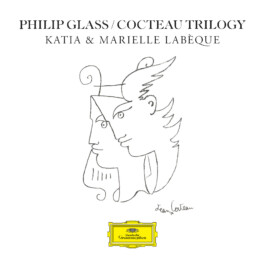
PHILIP GLASS COCTEAU TRILOGY
Orphée (1993)
La Belle et la Bête (1994)
Les Enfants Terribles (1996)
Release : 2024
CD1
Orphée (1993)
1 Le Café 3:41
2 La Route 1:26
3 La Chambre d’Orphée 1:59
4 Chez Orphée 2:11
5 Le Voyage aux Enfers 1:58
6 Orphée et la Princesse 3:27
7 Interlude Musical - Le Retour chez Orphée 1:44
8 Le Studio d’Orphée 3:22
9 Le Retour d’Orphée 2:53
10 La Chambre d’Orphée 4:30
La Belle et la Bête (1994)
11 Ouverture 1:12
12 Les Sœurs 1:22
13 Le Dîner 3:09
14 Promenade Dans le Jardin 7:38
15 La Saisie des Meubles 1:16
16 La Confiance de la Bête 4:21
17 Le Miroir 3:34
18 Le Pavillon 2:07
19 La Métamorphose 3:13
CD2
Les Enfants Terribles (1996)
1 Overture 3:02
2 Paul is Dying 4:57
3 The Somnambulist 3:51
4 She Slapped Me 3:51
5 They Lived Their Dream 2:16
6 Terrible Interlude 8:14
7 Cocoon of Shawls 3:36
8 Lost 5:13
9 Are You In Love, Agathe? 3:15
10 She Took the Path 1:58
11 Paul’s End 3:19

COCTEAU TRILOGY
NOTES
“La poésie s’exprime comme elle peut. Je lui refuse des limites. Je suis libre. J’ai fait un film ; dans cette époque, sans patries, j’ai sauté le mur des langues. Je ne suis pas un poète à buts. Je ne cherche ni les places, ni les récompenses, ni l’admiration. L’admiration me laisse froid. Mon œuvre exige l’amour ; j’en récolte.”
—JEAN COCTEAU « Essai de critique indirecte »
When I began work on the Cocteau trilogy, the first idea that governed my work was to bring out the underlying themes of the three films. They are best described as a pair of dualities – life/death and creativity being the first; and the ordinary world and the world of transformation and magic being the second. These topics are at the core of all three works and are explicitly put forward in the films. Whereas the first trilogy of operas (Einstein on the Beach / Satyagraha / Akhnaten) was about the transformation of society through the power of ideas and not through the force of arms, this second trilogy from the 1990s revolves around the transformation of the individual – the moral and personal dilemmas of a person as opposed to a whole people or society.
A corollary to this is the way in which magic and the arts are used to transform the ordinary world into a world of transcendence. These three films of Cocteau are meant as a discussion, description, and instruction on creativity and the creative process.
—PHILIP GLASS
In 1964, at the age of 27, Philip Glass moved to Paris to study under Nadia Boulanger. Their meeting would prove decisive in the young composer’s training and afforded him an immersion into French culture that left a lasting impression on the artist. His love of France also gave him a command of the French language that would help him to write and versify the operas that he dedicated to Cocteau during the 1990s.
In 2021, Katia and Marielle Labèque created the instrumental suites for two pianos taken from Philip Glass’s opera Les Enfants Terribles, based on the film by Cocteau. The success of both the record and their concerts – held at venues including the Philharmonie de Paris – left the pianists all the more eager to ask Philip Glass and his music director Michael Riesman to complete the trilogy by applying the same method to the remaining two operas in the Cocteau Trilogy: Orphée and La Belle et la Bête.
CREDITS
Katia & Marielle Labèque pianos
Two pianos version by Michael Riesman
Recorded, mixed and produced by David Chalmin, La Fabrique des Ondes,
November 2023 for La Belle et La Bête and Orphée,
July 2020 for Les Enfants Terribles, Dolby Atmos, November 2023
Mastered by Alexis Bardinet, Globe Audio Mastering
Pianos Steinway model D
Piano technicians Patrick Hinves and Teo Nesprias
Published by Dunvagen Music Publishers Inc.
Photography by Umberto Nicoletti
Photographs of Philip Glass from the archive of David Chalmin
Graphic design by Paschalis Zervas, + wolframgrafik
L'envoûtante "Cocteau trilogy" de Philip Glass par les sœurs Labèque
STÉPHANE RENARD (L'ECHO)
23 mars 2024
READ HERE
Katia et Marielle Labèque concluent en beauté leur triptyque dédié à Cocteau
Les sœurs pianistes consacrent leur nouvel album à trois œuvres de Cocteau mises en musique par Philip Glass : “Orphée”, “La Belle et la Bête” ainsi que “Les Enfants terribles”.
Sophie Bourdais (TELERAMA)
11 mai 2024
READ HERE
Les Labèque en ambassadrices de la Trilogie Cocteau de Philip Glass
Il était logique que Deutsche Grammophon permette à Katia et Marielle Labèque de parachever leur immersion pianistique dans la Trilogie Cocteau de Philip Glass.
Jean-Luc Clairet (RESMUSICA)
17 mai 2024
READ HERE
À Fourvière, les fantastiques sœurs Labèque s’emparent de trois opéras composés par Philip Glass et consacrés aux films de Jean Cocteau. Ces Suites, arrangées pour deux pianos, bénéficieront d’une scénographie originale faisant appel aux arts numériques.
—Guillaume Médioni
Juin 26, 2024
The Labèque Sisters peer into the Mysterious Worlds of Philip Glass and Jean Cocteau
“There’s an inexplicable magic in Glass. Beginning with just a few notes, very simple material, his music unfolds emotions that are unexpected. Glass carries us away somewhere else. The music can have delicacy in a minimalist motif and there are also spectacular flights of lyricism”.
— Katia Labèque
“I never cease to be amazed when I hear myself accused of being fanciful, facetious, without understanding a word of those reproofs. For the simple reason that… my works are the result of serious calculations that consist in changing figures into numbers, which puts me in the ranks of those blood donors, the only artists I respect, fascinated as I am by the long red train of blood they leave behind them.”
— Jean Cocteau
“Cocteau is teaching about creativity in terms of the power of the artist, which we now understand to be the power of transformation.”
— Philip Glass
I sometimes wonder how much Jean Cocteau is actually remembered today - is watched, read about, discussed with the urgency he himself expected, that he inspired in his day through his unique and eclectic body of work.
Jean Cocteau’s films alone were enough to inspire considerable attention and discussion back in the day, and that was hardly his only domain of creativity. He was also an important and influential writer, poet, artist, designer, collaborating with many of the major creative figures of the early 20th century. His films seemed to inhabit their own worlds, worlds in which magic, the supernatural, the mythic held hands with us as we walked down the street. In Orphée (Orpheus) this was a world in which a man could walk through a bedroom mirror to enter the vale of shadows and attempt to retrieve his newly deceased beloved.
....
—Mark Wark
August 20, 2026
PRESS BOOK
PRESS BOOK RECORDINGS
NEWSLETTER
Sign up for our newsletter so you don't miss any news
Site by Daniel
PRESS BOOK
PRESS BOOK RECORDINGS
NEWSLETTER
Sign up for our newsletter so you don't miss any news
Site by Daniel